How AI agents take audited financial statement review from a months-long reading exercise to a same-day result, and what a careful investment office needs to see before it trusts them with the work.
This is a composite scenario drawn from Romina Day's work with lean investment offices. Institutional details are generalized, and figures are typical ranges rather than one client's results. Romina Day is live with university endowments and foundations in North America and an endowment in the United Kingdom.
In brief
- A lean endowment investment office with around 70 external managers spends hundreds of analyst hours every year reading audited financial statements and keying figures by hand.
- It deploys one of the MATES, our multi-agent teams, from Romina Day, the intelligence layer for investment operations: AFS Review & Material Flagging, configured to the office's own review criteria.
- Audited financial statement review for the full manager roster goes from months to the same day. Every figure and every flag links to its source page.
- The team does not shrink. Analysts move from data extraction to manager conversations, re-underwriting and committee preparation.
- What earns trust: an audit trail the auditor can follow, deployment in the office's own environment on the models it approves, human sign-off on every consequential step, and a walkthrough of the workflow before anything is committed.
Why does audited financial statement review consume so much analyst time?
Every manager sends its audited financial statements in its own format, in the same few weeks, and each one runs 100 to 400 pages. An endowment with 70 managers reads well over 10,000 pages a year to find 20 to 60 data points per statement, and the reading is done by the same senior people who are meant to be exercising judgment.
The office in this scenario is typical of a $4 billion endowment: a seven-person investment team covering a CIO, a handful of investment professionals and a small operations and finance function. More than half of its external managers are in private markets.
For each statement the office needs valuation methodology, Level 3 assets, related-party exposures, fee and expense allocations, liquidity and concentration. An analyst reads, keys the figures into a spreadsheet and bookmarks the pages. A second person checks the keying before the investment team can use any of it. That typically adds up to 30 to 50 hours of analyst time per manager before any analysis begins.
The full portfolio takes months. The longest statements get skimmed when time runs out. Changes from the prior year are caught late, or only when a manager mentions them. The checklist for 50 to 150 managers' audited statements usually lives in one person's head. And the people doing the reading are the same people reconciling the custodian, processing capital calls and assembling the quarterly committee pack, while boards ask sharper questions every year about fees, private-markets valuations and manager concentration.
What is audited financial statement (AFS) review?
Audited financial statement (AFS) review is the annual process in which an allocator reads each external manager's audited financial statements to extract key figures, check them against expectations and the prior year, and surface anything a committee, auditor or tax adviser needs to know. For endowments and foundations it sits inside manager due diligence and ongoing fund monitoring, and it is one of the most repetitive tasks in investment operations.
What does AI for audited financial statement review look like?
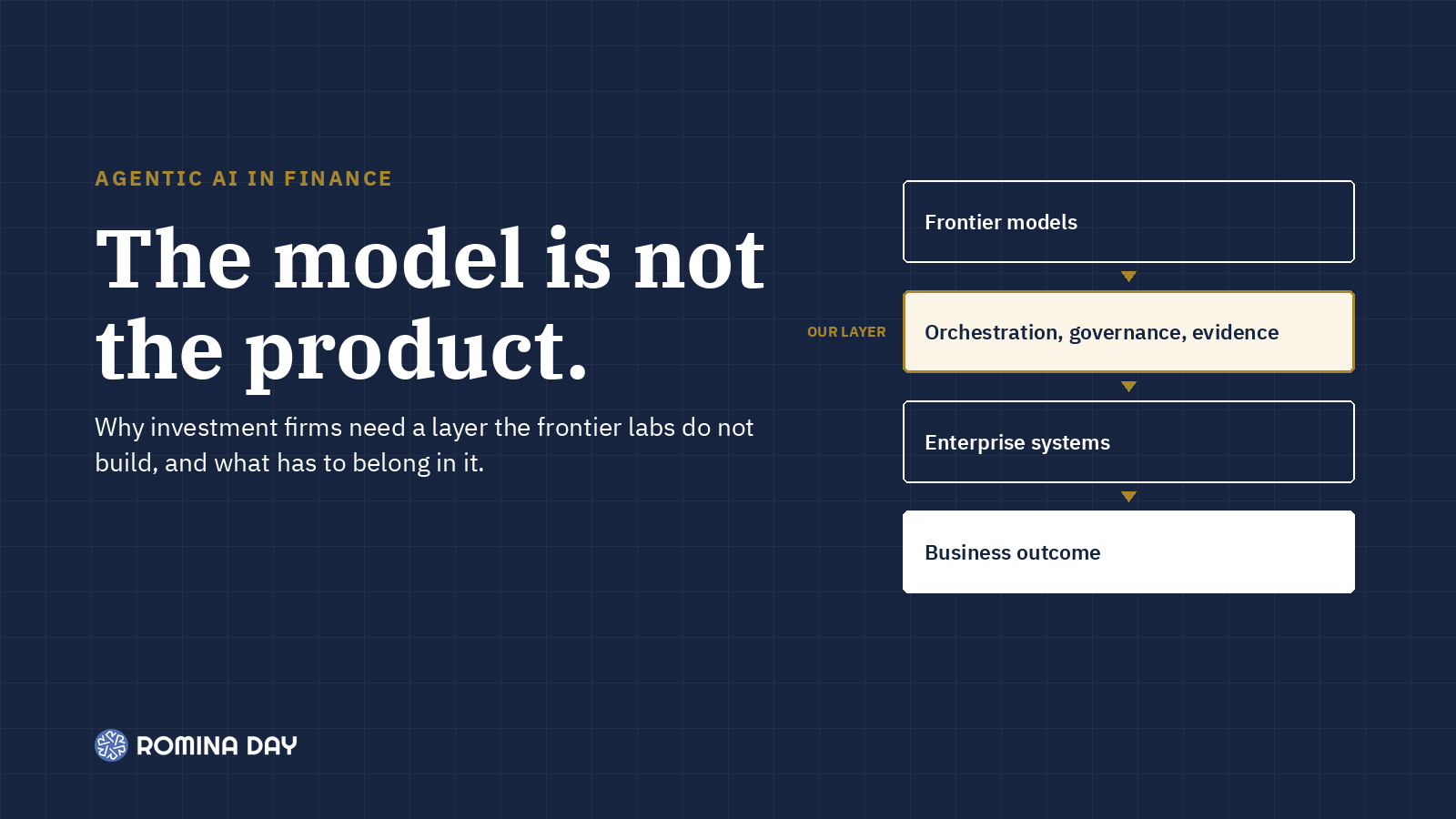
The office deploys AFS Review & Material Flagging, one of the MATES that make up Romina Day's intelligence layer for investment operations: AI agent teams that run a firm's most complex, repeatable work, configured to its methodology and delivered in minutes rather than days. A MATE is a team of AI agents, each with a defined role, that runs a single operational workflow end to end inside a governed process: ingest, classify, extract, test against thresholds, flag exceptions by materiality, and attach every result to the page and line it came from. The output is one risk card per fund, exceptions first, every figure linked to its page, and an audit-ready alert register. It is live in days, not months.
The office starts with one workflow, not a platform. Tie-outs and recalculations are rule-based and logged; only the diagnosis reasons, and it shows its sources. Reasoning runs on frontier models, routed across more than one provider. The judgment stays with the team.
Configuration takes hours of the office's time, not weeks. The office's own review items, red flags, tolerances and severities become the MATE's review criteria. That is configuration rather than code: when the investment committee later adds a check on manager-level leverage, it is a criteria change, not a rebuild. Before anything goes live, the MATE runs on the prior year's statements, where the team already knows what the answers should be. The AFS review template is the starting point; the office's workflow is what it is configured to. See how MATES are configured to each firm's own processes.
Manual review versus MATE review
What changes for the investment office?
Review of the full manager roster's audited financial statements completes the same day the statements are in, against a cycle that used to take months. Every statement is read in full, exceptions are ranked by severity with a source page behind each, and no figure is keyed by hand. The people who ran the review still run it; they adjudicate exceptions instead of typing.
Days into minutes. Not five percent sampled: every statement, against the office's own procedure. A full-coverage review surfaces the items a manual review tends to miss under deadline: a change in valuation policy, a new related-party arrangement, a shift in how fees and expenses are allocated to the fund.
Every figure traced to source. When the auditor asks how the office satisfied itself on Level 3 valuations across the portfolio, the answer is the risk card and the activity log: a source page behind every figure and a record of every check.
The same answer, every time. A 400-page statement gets the same review as a 100-page one, and the review is identical next year. That is what makes the output comparable across managers and defensible in front of a committee.
Start with one workflow, live within days. Most firms add the next within a quarter, once the first has earned it. Nothing you already run gets replaced.
Want to see how the AFS review template is configured to your team's workflow? Book a 30-minute walkthrough. Nothing to prepare, nothing to sign.
What do the analysts do now?
Investment judgment, not data processing. The office stays the same size. Manager calls use the flagged exceptions as the agenda. Watch-list re-underwriting happens on schedule. The committee pack is assembled with time left for commentary rather than tied out in the days before the meeting. Reconciliation and capital call processing are in the library, sequenced on the same configuration once the first workflow has earned it.
What does a careful institution need to see before trusting AI with AFS review?
Four things: an audit trail the auditor can follow back to the page; deployment in the office's own environment, with visibility into which model handled which step; a named person signing off on every consequential step; and a walkthrough of the workflow on sample data, then a run on its own statements, before any commitment. Endowments are not early adopters by temperament, and a good CIO asks each of these before proceeding.
Can the auditor follow it? Every check is logged with its source and its reasoning as it happens, not reconstructed afterward. The CIO, the committee, the auditor and the tax adviser can each trace any figure to the page it came from.
Where does our data live? Single-tenant by default; private cloud or on-premises where your policy requires it; on the models you approve. Never used to train shared models. The office can see which step ran on which model and change models without changing how the workflow runs.
Who decides? The agent team runs the workflow from intake to exception. A named person signs off on every consequential step. Nothing leaves the process on the authority of a machine.
Can we see it on our own statements first? Yes, at the right stage. The first call is a thirty-minute walkthrough of the AFS review template on sample data, with nothing to prepare and nothing to sign, and it shows how the template is configured to your team's own checklist, tolerances and severities. A run on your own statements comes later, under NDA.
The objections every investment office raises
Why not just use Claude or ChatGPT for financial statement review?
Claude is an excellent front door; keep using it. A frontier model gets one document most of the way there. MATES are for the thousandth, where there is no margin for error. AFS review is that kind of work: dozens of statements against dozens of criteria with defined tolerances, output in the office's own format, exceptions ranked by materiality, every figure traced, every step logged, and the same result next year.
With a general model, the outcome depends on who wrote the prompt and which model answered. With a MATE, the methodology is yours, the controls are set, and every run leaves a record. Each step is a specialist: reconciling figures is a different job from drafting a review note, and separating them makes each one testable. Reasoning runs on whichever model suits the step, and the workflow can route across providers, so one provider's outage does not stop the year-end review. The models inside are frontier models. The difference is everything around them, and that is what turns a chat answer into a structured, review-ready, audit-ready output.
Why not build it ourselves?
You can build the agent. The cost is everything after it. Some offices try, and most stop at a script that handles one manager's format, maintained by the one person who wrote it. The hard part is not extraction. It is classifying arbitrary formats, exception logic, traceability, security, audit logging and regression testing every time a model or a manager's reporting changes, and the question a board will eventually ask: what did this cost to build, and what return has been measured? Romina Day arrives with the testing, monitoring and change control already built, deploys in days, and operates the MATE in production, so there is no AI stack for the office to maintain.
What happens to the team?
The MATE reads; your team decides. The constraint on a lean investment team is not headcount but the share of each person's day consumed by structured reading. The MATE takes the reading and extraction; what remains is the work that justified hiring an investment professional: judging what the flags mean and deciding what to do. Same team, wider coverage, and the next hire avoided rather than made.
Worth thirty minutes on one workflow?
Most endowments and foundations start exactly here: one workflow, one team, one result they can defend to a committee. If next year's audited financial statements are going to land on the same few people, now is the time to change how they are read.
In a 30-minute walkthrough with Romina Day you will get:
- A guided walkthrough of the AFS review template on sample data: what the MATE reads, what it flags, and what the risk card and alert register look like.
- How the template is configured to your team's workflow: your checklist, tolerances and severities become the review criteria, with no code.
- A value case in your own hours, based on your manager count, statement volume and team time.
Nothing to prepare, nothing to sign, and your data stays in your environment.
Book your 30-minute walkthrough →

Written by
Conor Walsh, CEO & Co-Founder, Romina Day
Conor Walsh is CEO and co-founder of Romina Day, where he leads the development of multi-agent AI systems that automate investment operations for institutional allocators and asset managers. He has helped take two companies public, first as an investment analyst advising institutional investors and later as an operator leading capital markets and financial operations.