The frontier labs build the intelligence. Someone still has to engineer the work around it. For an investment firm, the real question is which layers you build yourself.
In brief
- Frontier models from the major labs are extraordinary and improving every quarter. They also ship agents, tools and enterprise platforms. None of that is in dispute.
- What they are not built around is a specific investment workflow: its documents, controls, sign-offs, exceptions and evidence. That is a different layer, and every firm has to assemble it somewhere.
- Agentic AI in finance works when each step of a workflow runs on the right engine, including deterministic code where the answer must be exact, and when the firm owns the context, permissions and evidence.
- Romina Day, the AI multi-agent platform for asset management, is that layer. The labs build the intelligence. Romina Day engineers the work around it.
Why does this question keep coming up?
Because most investment firms now license at least one frontier platform, and someone in technology reasonably asks why they would add anything on top. It is the right question. The answer is not that the platform is weak. It is that the platform and the investment workflow are built around different goals, and the gap between them is where most internal AI programs stall.
That gap is not capability. The models can read a 300-page financial statement, reason about a valuation policy and draft a clear note. The gap is everything that makes that reading repeatable, testable, governed and auditable across 100 managers, every quarter, with a named person signing off.
What is agentic AI in finance?
Agentic AI in finance uses AI agents to automate complex investment and operational workflows that would otherwise require multiple people, systems and manual steps. Rather than simply answering questions, these agents work together to collect information, analyse documents, validate data, identify exceptions and complete tasks. Each agent has a defined responsibility, with built-in controls, audit trails and human oversight to ensure accuracy, accountability and compliance.
Two layers, two design goals
The frontier labs are built for breadth across every domain, model capability and reasoning quality, developer tools and agent primitives, and rapid release cycles. They are meeting those goals, and nothing here argues otherwise.
A vertical layer for investment operations is built around different things: financial documents and their structures, controls, sign-off and exception handling, repeatability and auditability of every run, and savings measured against the firm's own baseline. The model provides capability. The vertical layer makes it operational and auditable. Romina Day makes sure every innovation of the LLM is captured and every change in the underlying technology stack is interoperable.
The two grow together. Every capability release from the labs makes the workflows built on them better, at no additional cost to the firm.
Which layers should a firm build itself?
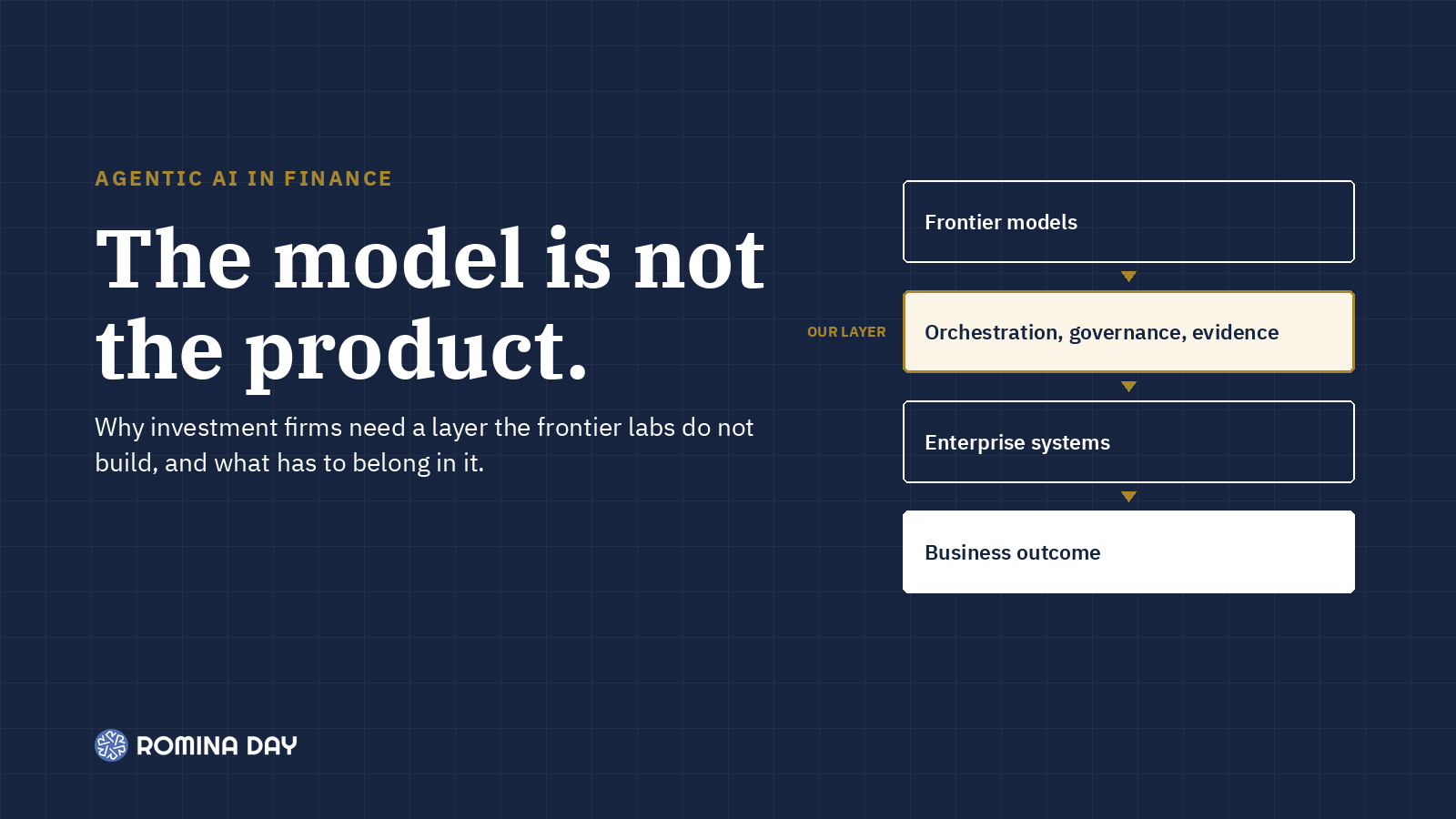
Every firm assembles four layers: frontier models at the top, an orchestration and governance layer, the firm's enterprise systems, and the business outcome at the bottom. Firms buy the models and already own their systems. The question is who builds the layer in between, and who maintains it.
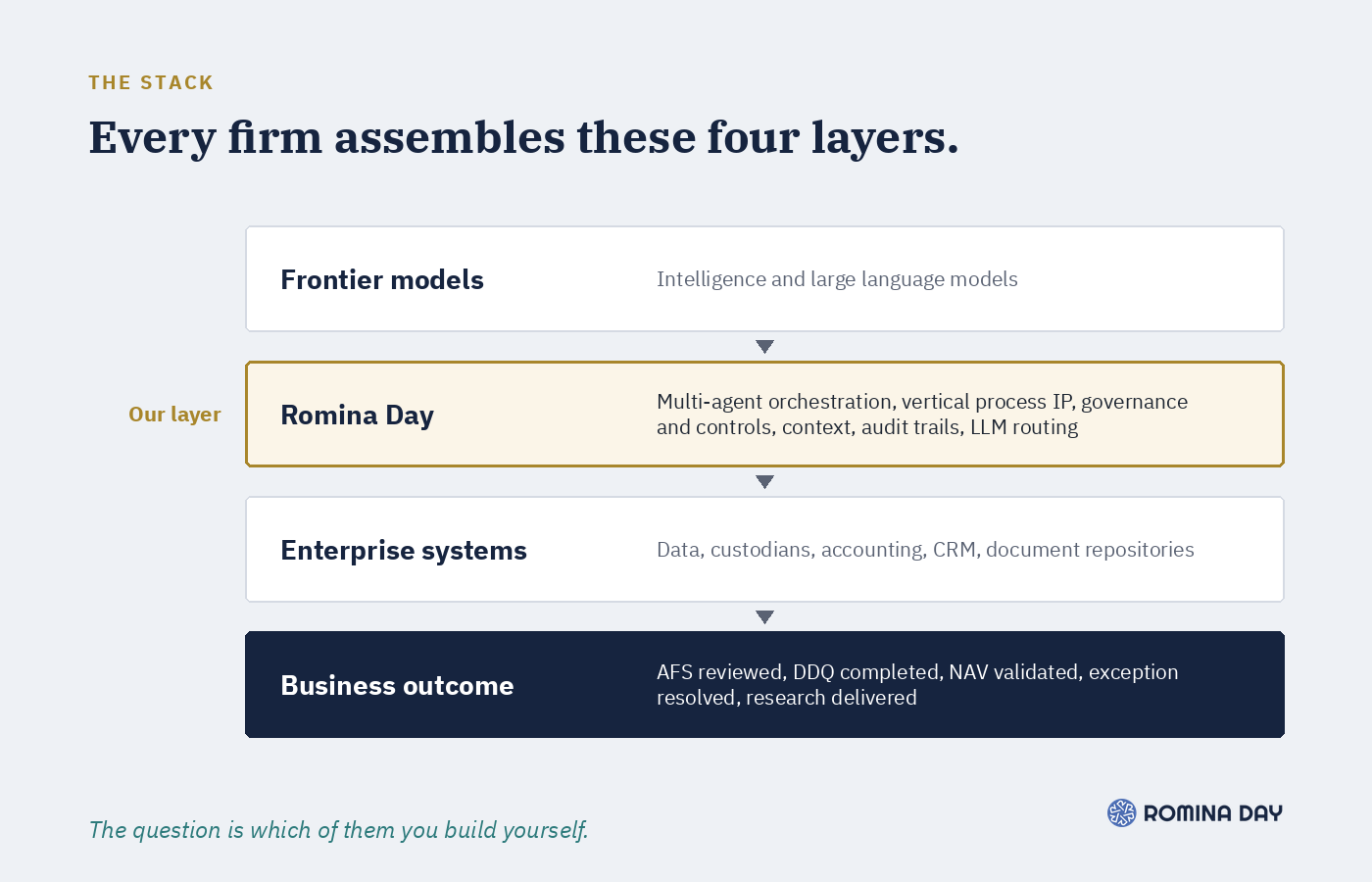
Most buyers place themselves on this stack immediately. The ones building internally are usually building the second layer, often without calling it that.
Why is one model only one component?
Because an investment workflow is a sequence of different jobs. Extraction, validation, reconciliation, reasoning, review, exception handling and QA are separate tasks with separate requirements. Reconciling figures is not the same job as drafting a review note, and separating them makes each one testable on its own.
Separate steps can run on separate engines. Reasoning can run on whichever frontier model suits it. Arithmetic, validation rules and formatting should not be a model at all: they run as deterministic code, where the output is exact by construction. And because steps differ on cost, data handling and capability, the firm can nominate what runs where and change it without rebuilding.
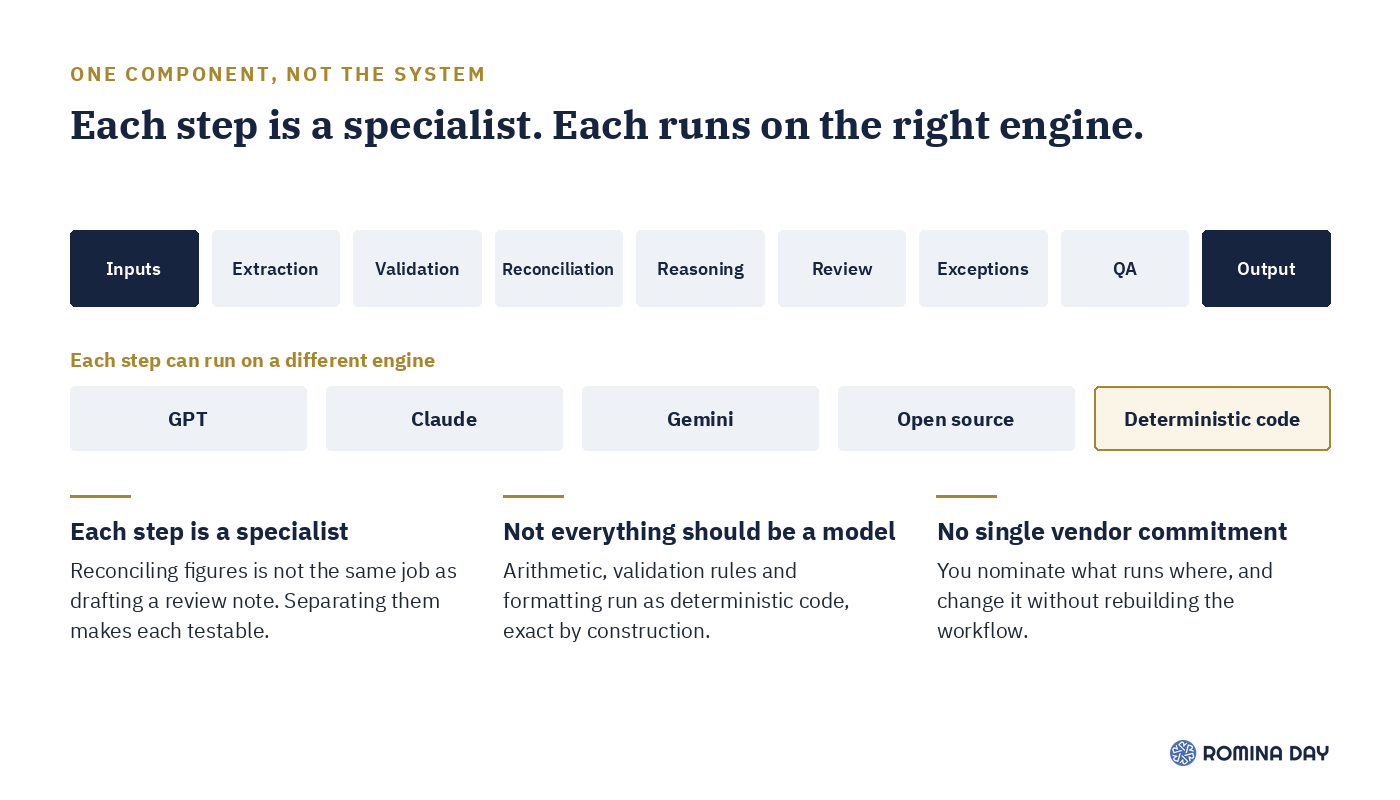
The value is not choosing the best model. It is orchestrating the best combination of models, agents, controls and deterministic systems for each step. A MATE (Multi-Agent Team Engine) is Romina Day's unit for that: one named workflow, each step declared, running on a cadence with defined controls, evidence and owners. See how MATES route each step across engines.
There is a resilience argument too. Every major provider publishes an incident record, and none of them is empty. A workflow bound to one provider stops when that provider does. A workflow that can route across providers does not. For a board-level view of single-provider risk, see our analysis of AI counterparty risk.
What does a board need the firm to own?
As agents move from assisting people to executing work, the orchestration layer becomes part of the firm's operating fabric, and a board or regulator will ask six questions: where the intelligence resides and who controls it, which models are making which decisions, what enterprise knowledge they access, whether the firm can explain why an action was taken, whether it can change models without rebuilding, and whether the knowledge its agents create belongs to it.
Answering them requires the firm to own six things: context (how AI understands the organization), knowledge (what it can reason across), orchestration (how work moves across agents, systems and people), permissions (what agents may do and where a human must approve), evidence (how every action is observed and audited), and learning (what the firm retains from every piece of work).
Owning that does not mean building foundation models. It means owning the layer above them. Models can be rented. Agents can be bought. Enterprise intelligence has to be owned.
What still has to be built on a general platform?
Everything that turns a capable model into a production workflow. The comparison is not one system against another. It is what arrives built against what the buyer still has to build.
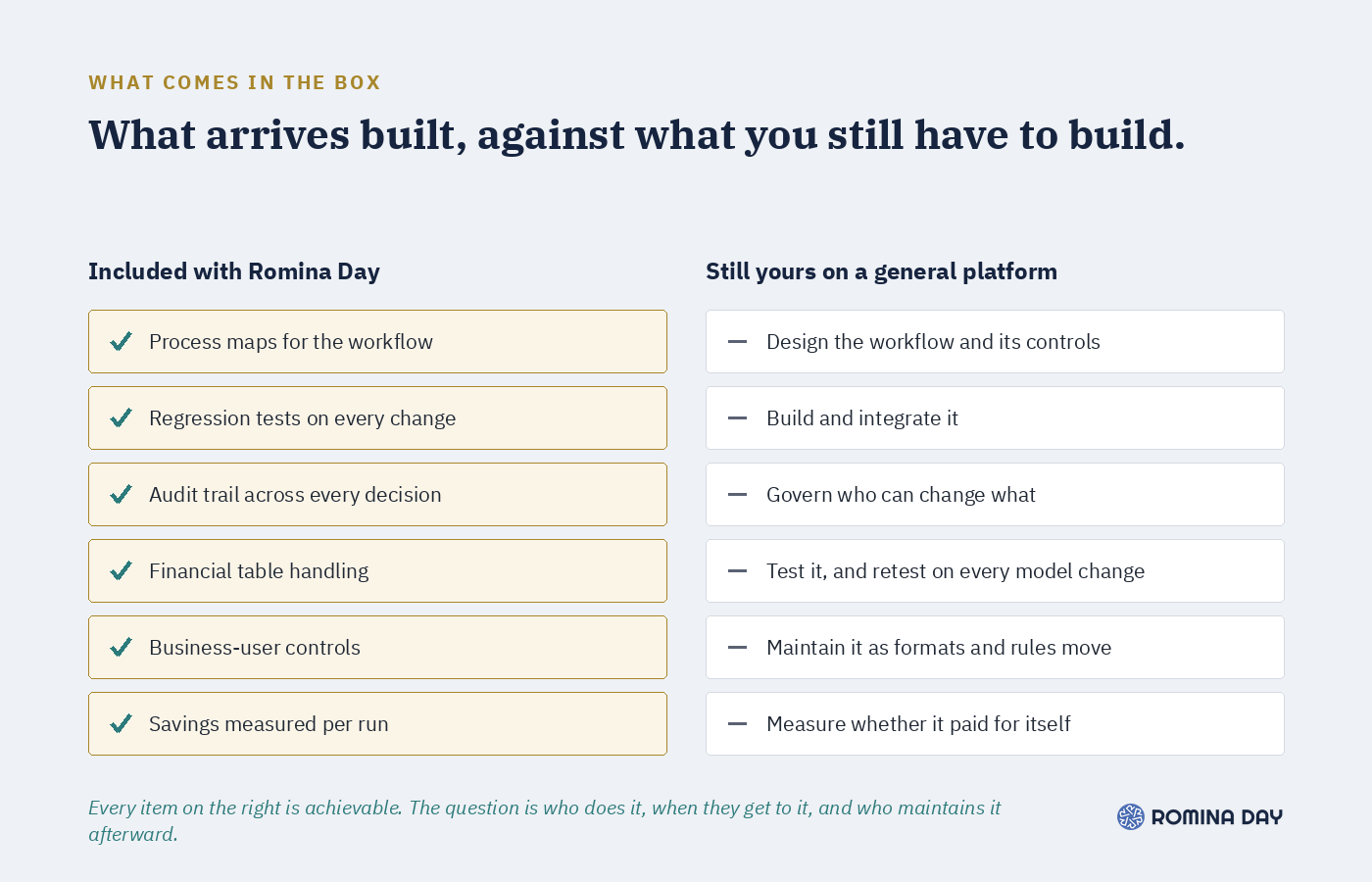
Every item on the right is achievable, and a strong technology team can do all of it. The question is who does it, when they get to it, and who maintains it afterward, particularly when the model underneath changes and every test has to run again.
How should the spend behave?
Usage-based AI spend scales with consumption and is hard to forecast, because much of it goes on building rather than running. Enterprises have publicly reported exhausting annual AI budgets within months. The alternative is spend tied to output: per financial statement reviewed, per NAV pack completed, per DDQ processed. Volume can be forecast, and every dollar is attributable to business output.
Three questions are worth asking of any internal AI program: what has it delivered into production so far, what did that cost to build, and what return has been measured on it?
The objections worth answering directly
"Our AI team can build this."
They probably can. The question is scope, not competence. Building means integrating, testing, governing and maintaining every workflow as models, formats and rules change. A single missed case can cost $35,000–$60,000 in remediation and audit.
With Romina Day, a MATE deploys in days, and we handle technical testing, monitoring, recalibration, versioning and audit evidence. Your team retains control of policies, risk thresholds and governance decisions, without the ongoing maintenance burden.
"The frontier platforms ship agents now."
They do, and they are good. They are also general by design. An agent platform gives a firm the primitives; it does not give it a process map for audited financial statement review, a regression suite for NAV validation or an exception taxonomy for capital calls. The distinction is layer, not capability.
"Aren't we just swapping one dependency for another?"
No. A single model provider is a dependency the firm cannot see into or replace. The orchestration layer is frontier lab agnostic and the part the firm configures and controls: which engines, which permissions, which approvals, which evidence, in its own environment. The criteria, logs and outputs stay with the firm.
"What happens when the models get better?"
The workflows get better with them, at no additional cost. That is the point of separating the layers. The firm keeps its process, controls and evidence stable while the engine underneath improves.
Where to start
One workflow. One baseline. Thirty minutes to determine what can be automated, measured against how the work runs today. No demo, no pricing, no pilot scoped in the room.
If your firm is weighing an internal AI program against a vertical layer, start with thirty minutes on one workflow.