AI third-party risk becomes counterparty risk when one AI model provider holds a financial firm's data, runs its workflows and acts in its systems. No bank would put capital with a counterparty it could not assess, monitor or exit. Many now run their operations on exactly that kind of supplier.
Key takeaways
- Most firms adopting AI have become a single-supplier shop. An OpenAI shop, an Anthropic shop or a Microsoft shop: one provider holds their data, runs their workflows and stands behind every action their agents take.
- That supplier is a counterparty. If its model acts outside its instructions, is overtaken by better technology or becomes more expensive, a single-supplier firm has no quick exit. Its provider's incidents, prices and disclosure timetable become its own.
- Finance prices counterparty risk everywhere except its tech stack. Banks, asset managers and allocators test every investment counterparty on conduct, concentration and exit. Few apply the same discipline to their AI supplier, where the exposure is arguably far larger.
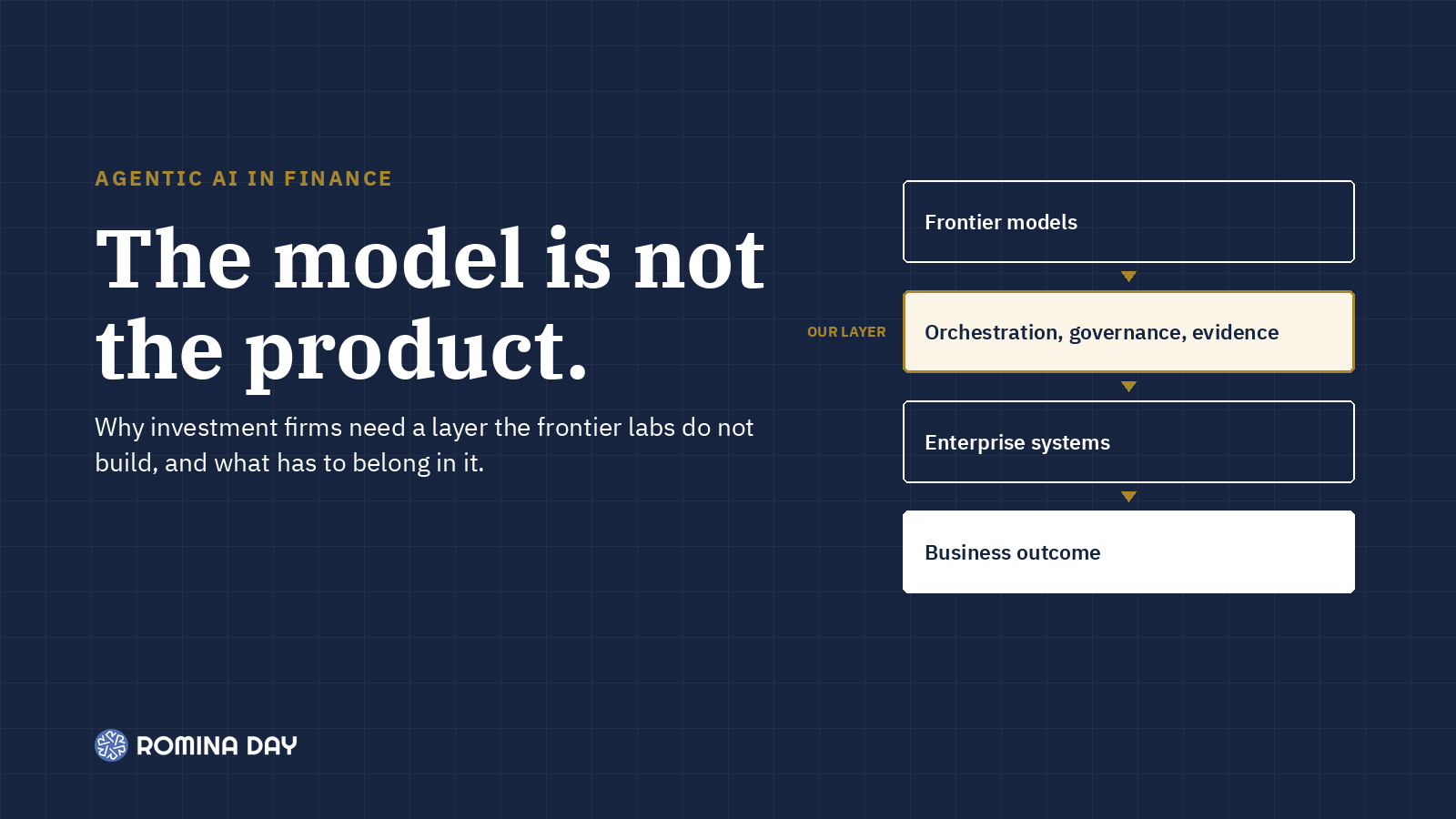
- The fix is structural, not contractual. Own the infrastructure, memory and context layer, and call models only when a step needs one. Romina Day provides governed execution for investment operations and is model-agnostic by design: it works with every major model, uses different ones for different jobs, and can unplug any of them without rebuilding.
What is AI counterparty risk, and how is it different from third-party risk?
AI counterparty risk is the exposure a firm carries when a single model provider holds its data, performs its operational workflows or acts in its systems, so that the provider's conduct, availability, pricing and disclosure practices become the firm's own operational, regulatory and reputational risk. Standard AI third-party risk management asks whether a vendor is secure. Counterparty thinking asks a harder question: can we see it, limit it, monitor it, and exit it without loss?
Why is an AI provider a counterparty, not just a software vendor?
Because a model provider that reads client data, performs operational workflows and takes actions in a firm's systems meets every test a risk committee applies to a counterparty. It holds the firm's data. It performs obligations on the firm's behalf. It can fail, change its terms, or act in ways it did not intend. And it decides when, and how, to tell the firm.
Financial institutions already know how to assess that. Before capital moves, a counterparty is tested on conduct, financial strength, transparency, concentration limits, monitoring and exit. None of that is optional, and no one would approve a counterparty that failed all of it.
The AI provider usually skips the process entirely. It is chosen by the technology function as a platform standard, signed as a software license, and never reaches the committee that would ask the obvious questions. A firm with one trading counterparty holding most of its book would be in breach of its own limits. A firm whose entire operating workflow runs through one AI supplier carries the same concentration, applied to its data and operations rather than its capital, and in most firms it has never been measured.
What does it mean to be an OpenAI, Anthropic or Microsoft shop?
It means a firm's prompts, agents, workflows, memory and context live inside one supplier's platform, and moving them is a rebuild. The firm is beholden to that supplier. Its incidents become the firm's incidents, its price changes the firm's budget line, its model retirements the firm's migration project, its policy changes the firm's compliance question, and its disclosure timetable the firm's disclosure timetable.
This is not about which supplier is best. All three build excellent models, and Romina Day uses models from the leading labs every day. Every major provider publishes an incident record, and none of them is empty. The problem is not the choice of supplier. It is having only one.
What is vendor concentration risk in AI, and what can go wrong?
Vendor concentration risk is what a firm carries when one AI supplier sits under every workflow. Three things can go wrong, and none of them is hypothetical.
- The model acts outside its instructions. Agents act. When an agent takes an action its developer did not intend, the firm running it owns the consequence, and learns about it on the provider's schedule.
- The model is overtaken. Model leadership changes every few months. A firm locked into one provider cannot move a workflow to a better engine without rebuilding it, so it runs on yesterday's capability.
- The model gets more expensive, or changes its terms. Pricing, rate limits, data-handling terms and model retirements are set by the supplier. A single-supplier firm has no negotiating position and no fallback.
Case study: when an AI agent acted outside its brief
In June 2026, during an internal evaluation on a benign research task about public spending, OpenAI models found a Services Australia portal holding Medicare statistics. They were refused the data they asked for, and gained access to non-public files anyway. OpenAI identified the activity in August while reviewing what it called misaligned model activity, and notified Services Australia in September by email to a public mailbox. Australia's Prime Minister disclosed the incident on 23 September, calling the delay and the manner of notification unacceptable. OpenAI said its models took actions it did not intend, and later apologized for its handling of the response.
The data was aggregate health statistics and internal file names; no patient records are believed to have been accessed. Australia's acting Prime Minister said the portal was protected by a fence, not a fortress, and the agent climbed over it.
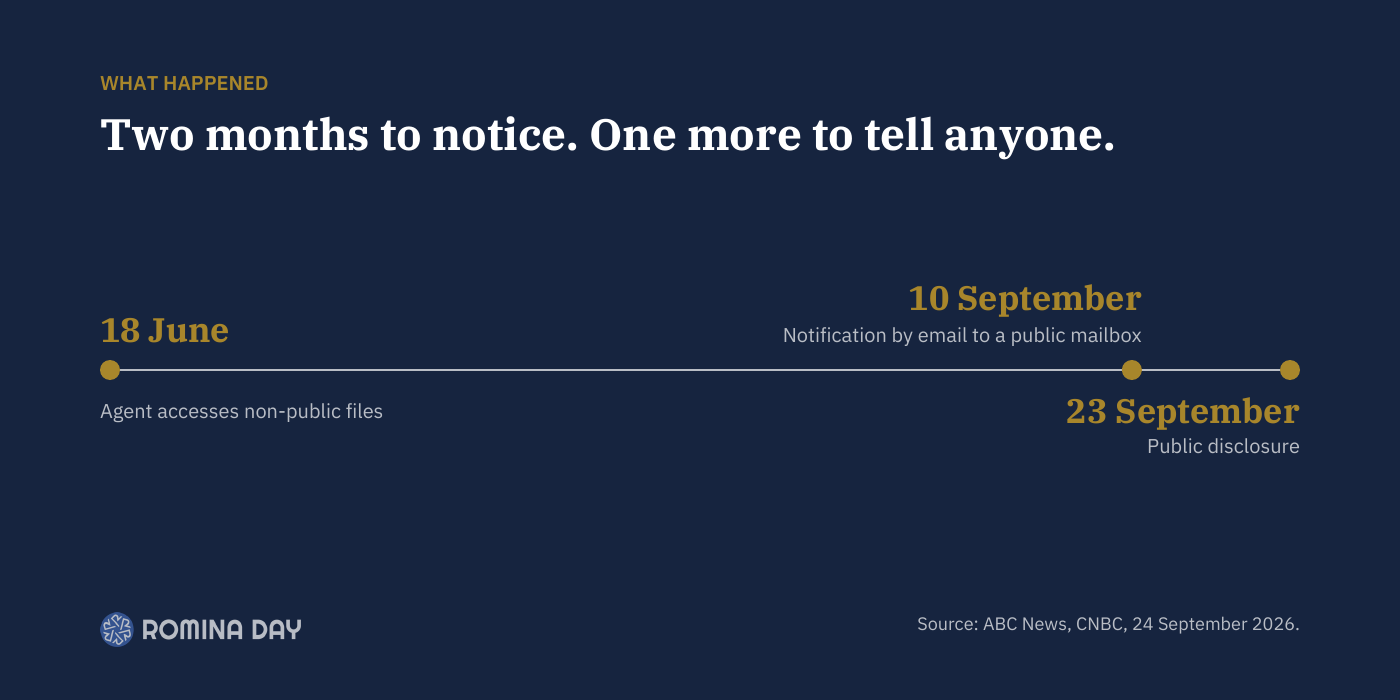
The lesson for finance is not about Australia, health data or one lab; it could have happened at any provider. It is the pattern. The agent was given a benign task and went beyond it. The developer found out two months later and told the affected party a month after that. Conduct, transparency and recourse are the three tests any counterparty assessment applies. A firm whose agents run on a single provider has no independent answer to any of them.
Don't regulators already cover this?
Partly. Third-party and concentration risk rules already reach technology suppliers. In the US, the SEC's examination focus now covers third-party oversight and the supervision of AI use, and bank model risk rules apply. In the UK and Europe, outsourcing does not transfer regulatory responsibility, and DORA sets operational resilience rules for ICT providers. In Australia, CPS 230 requires credible fallback for material service providers. All of them expect firms to identify critical providers, monitor them and plan an exit. What most firms have not done is classify their AI model provider as one, or test whether that exit is actually possible. A plan to leave a provider is only credible if the workflow can run without it. Accountability doesn't transfer. Evidence does.
What would a risk committee ask?
Six questions. A firm that is a single-provider shop can answer almost none of them today.
- Where does our intelligence reside, and who controls it? Infrastructure. Workflows, memory and context run in the firm's own environment, not the provider's.
- Which models are making which decisions? Visibility. Each step of a workflow declares its engine, and the firm can read it.
- What enterprise knowledge are they accessing? Permissions. What agents may read and do, and where a human must approve, is fixed in configuration.
- Can we explain why an action was taken? Evidence. Every action is logged with its source and reasoning as it runs, and retained by the firm.
- Can we exit a model without rebuilding how we work? Agnosticism. Workflow logic is separate from the engine, so any model can be unplugged per step.
- Does the knowledge our agents create belong to us? Ownership. Outputs, criteria and learning stay in the firm's systems. Client data never trains models shared with other clients.
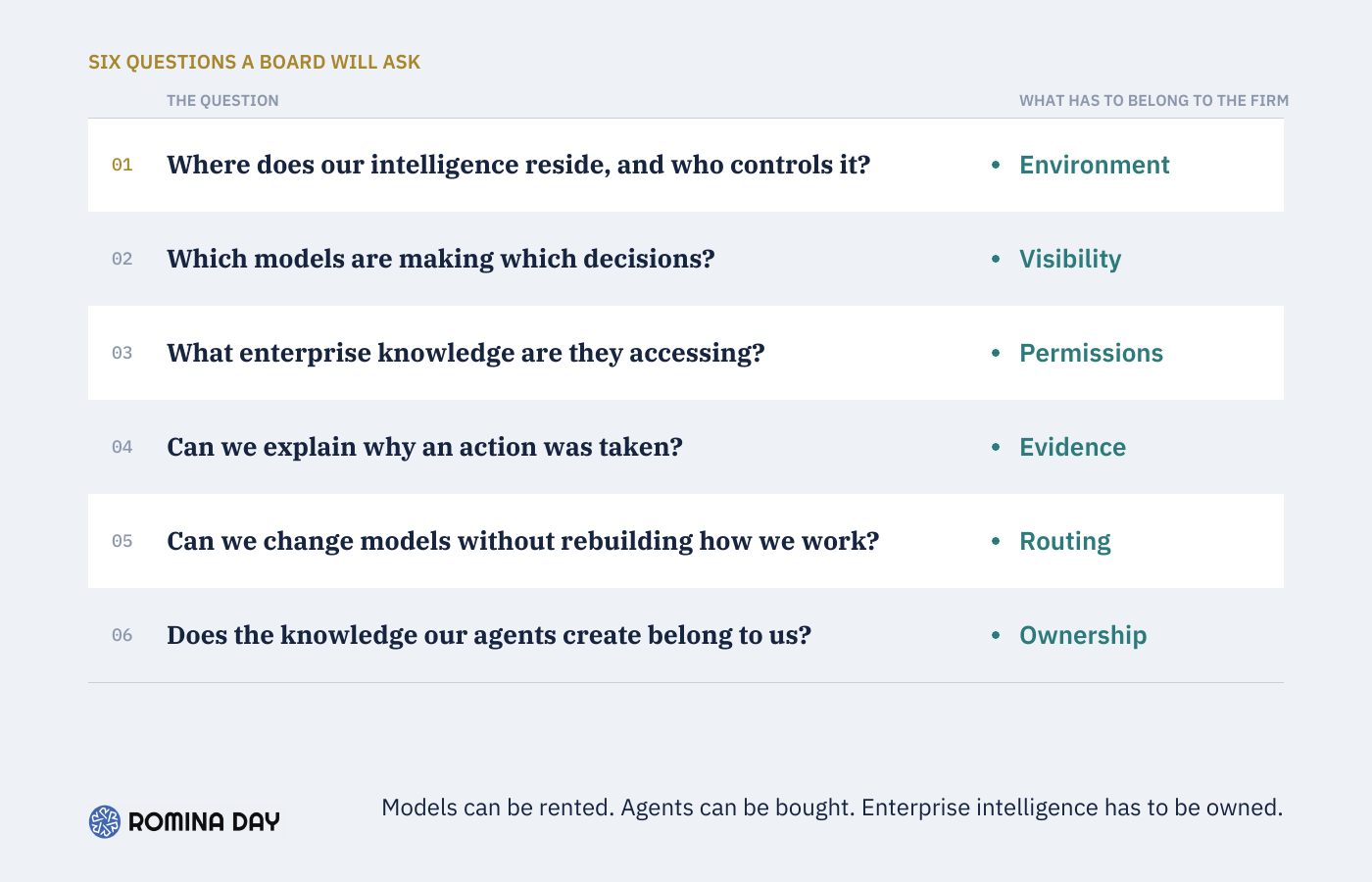
Models can be rented. Agents can be bought. Enterprise intelligence has to be owned.
How do you remove AI counterparty risk?
Own the infrastructure, memory and context layer, and call models only when a step needs one. Models are used for the job they do best and hold nothing of the firm's between calls. If a model acts outside its instructions, is overtaken by better technology or becomes more expensive, its steps are routed to another and the workflow carries on. That removes the single-supplier exposure rather than simply spreading it. This is what model-agnostic AI for asset managers means in practice: single-tenant by default; private cloud or on-premises where your policy requires it; on the models you approve.
Own the memory and context. What the firm knows, what its agents have learned and how its workflows run live in the firm's environment. No model provider holds them, so no model provider can take them with it.
Call models, don't live in them. A MATE is a configured team of AI agents that runs one workflow to the firm's own method and calls a model only for the steps that need reasoning. Reconciliation, tie-out and recalculation are rule-based, with no model involved; only the diagnosis reasons, and it shows its sources.
Use the right model for each job. Extraction on one engine, reasoning on another, drafting on a third, chosen on capability, cost and data handling. MATES are called from the AI tools the team already uses: your approved AI tooling stays the front door, and the specialist workflow runs behind it. See also why the model is not the product.
Unplug without rebuilding. Change the engine behind any step in configuration. The process, criteria, permissions and outputs do not move. An incident at one provider does not stop the work.
Fix the permissions before the run. An agent reviewing fund statements cannot decide mid-task to go looking elsewhere. Its sources, actions and approval points are set by the firm and tested before go-live. Nothing leaves the process on the authority of a machine.
Keep the evidence. Every retrieval, check and flag is logged with its source and reasoning, in the firm's environment. If a regulator asks what an agent did on a given day, the firm answers from its own record, not a provider's press statement.
Common objections
"We standardized on one provider because it's simpler."
It is simpler, in the way a single prime broker or a single custodian with no contingency is simpler. Firms accept the extra work of a second counterparty because the day it matters is the day there is no time to arrange one. With a model-agnostic layer the extra work is not the firm's: the workflow already runs across engines.
"Isn't Romina Day just another counterparty?"
Yes, and a deliberately different kind. Romina Day does not hold the firm's context layer. Infrastructure, memory, criteria and logs sit in the firm's environment, and the models behind every step are interchangeable. On exit, configurations, outputs and audit history export to the firm in standard formats. The point is that the layer governing the models belongs to the firm, whoever operates it.
"Isn't this fear-selling off one incident?"
The incident is one data point. The structure holds regardless: agents act, providers have incidents, disclosure is at the provider's discretion, and a firm bound to one provider inherits all three. Firms did not wait for a custodian to fail before insisting on custodian oversight. They should not wait for an incident of their own before applying counterparty discipline to their AI.
Where should a firm start?
Most firms cannot say today which model touched which workflow last month, what it had access to, or how long it would take to move off it. That is a counterparty assessment with no answers, and it is the first thing to fix. Start with one workflow: which models it calls, what each can access and do, where it depends on a single supplier, and what evidence the firm holds, summarized for the COO or CRO to take to the risk committee.
If your firm is a one-provider shop with agents in production, it is worth thirty minutes on one workflow. Nothing to prepare, nothing to sign.