Romina Day builds AI agents for financial services, configured as teams that run the work of investment operations. They handle the complex, repeatable work that allocators, wealth platforms, banks and fund managers do every day, from document QA to NAV reconciliations to due diligence, in minutes rather than days, the firm's own way every time, with every figure traced to its source and the firm's own people signing off.
In brief
- Investment operations still run on manual processes, and the workload compounds faster than teams can scale.
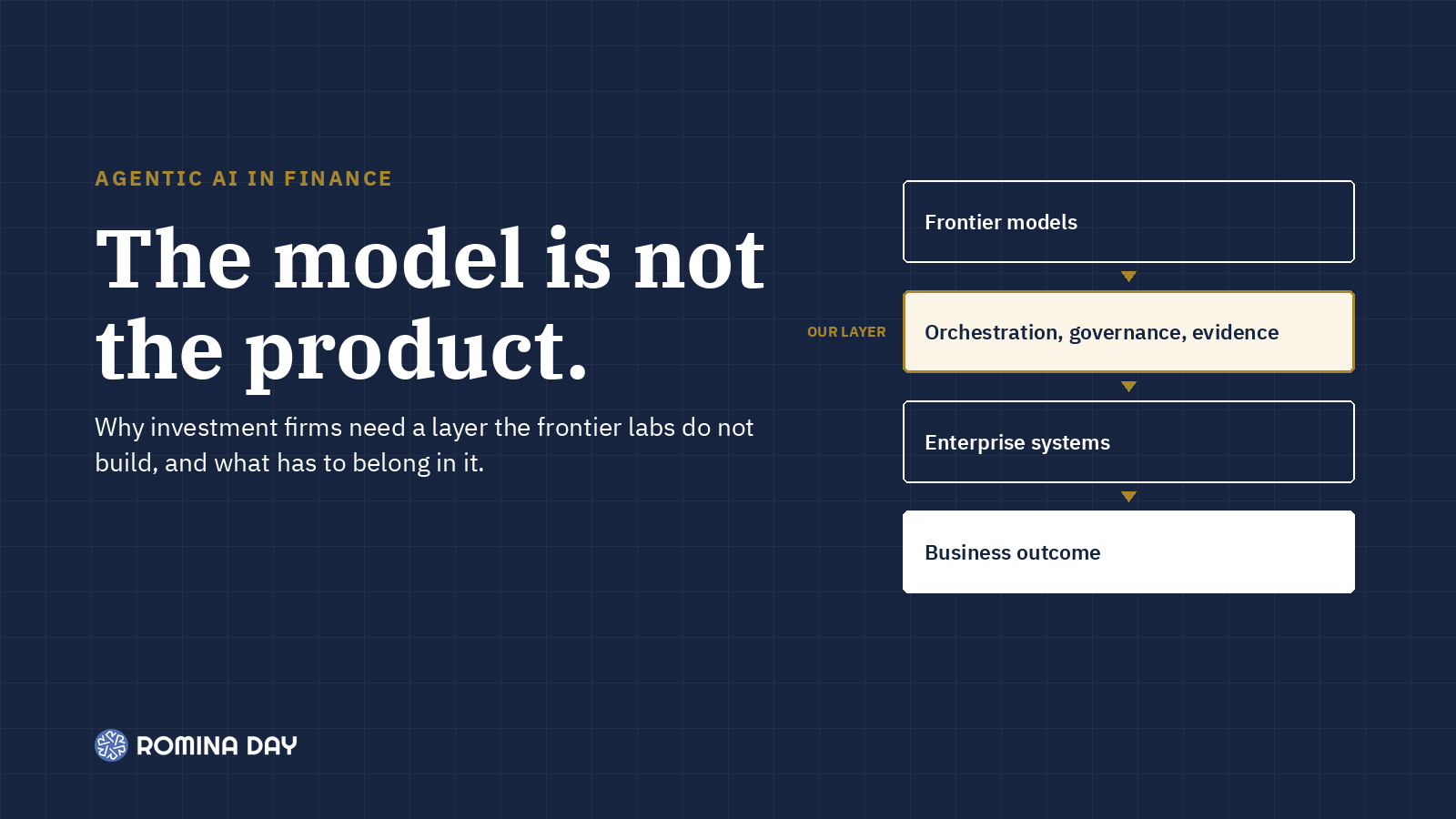
- A model alone gives a convincing answer. It doesn't apply an institution's methodology across thousands of documents, or produce a complete audit trail.
- MATES, our multi-agent teams, run one workflow at a time to the firm's own method, with an audit trail of every input, output and approval.
- Start with one workflow. Add the next once the first has earned it.
David and I built a wealth and asset management business, took it public, and spent years automating the operations behind it. We understand firsthand the complexity, regulatory obligations and operational pressures that come with managing institutional assets.
Our CTO, Peter Quintas, brings decades of engineering experience, including early work in machine learning and AI, and building HIPAA-compliant emergency response technology for highly sensitive, regulated environments. His background is rooted in developing systems where security, governance, accountability and reliability are fundamental, not afterthoughts.
Together, we combined deep industry experience with the engineering expertise to deploy AI securely, govern its execution and scale it across institutional workflows. We've operated these businesses from the inside. We understand the decisions, regulatory obligations and operational complexity they face, and why AI must be governed, auditable and accountable at every step.
Documents arrive in dozens of formats across disconnected systems. Investment teams spend days on due diligence, operations teams chase reconciliation breaks, and compliance teams struggle to keep pace with growing volumes and regulatory obligations. Institutional knowledge sits with individuals, processes remain manual, and exceptions surface too late. As portfolios, products and reporting demands grow, the workload compounds faster than teams can scale.
AI was supposed to change that. Firms have invested heavily in models and copilots that can read documents, analyse information and generate impressive answers. But a convincing answer is not a production workflow. A model alone doesn't consistently apply an institution's methodology across thousands of documents, enforce permissions, route exceptions for approval or produce a complete audit trail of what was done and why. The result is promising prototypes that struggle to reach production, growing concerns around data security and agent control, and investments with little measurable return. For a one-off memo, a useful answer may be enough. For the work an institution cannot afford to get wrong, it isn't.
Three forces are now converging. First, AI models have become capable enough to interpret the complex, inconsistent documents and data that underpin institutional investment operations. Second, boards, regulators and auditors are demanding more than promising demonstrations. They want to know where sensitive data goes, who controls the agents, how decisions are verified and who remains accountable. Third, portfolios and operational demands continue to expand faster than the teams responsible for managing them. For the first time, the technology is capable of addressing this complexity at scale, but only if institutions can deploy it securely, govern its execution and measure the results.
So we built the layer. Romina Day is the intelligence layer for investment operations: AI agent teams that run your most complex, repeatable work, from reviews to reconciliations to reporting, configured to your methodology and delivered in minutes rather than days.
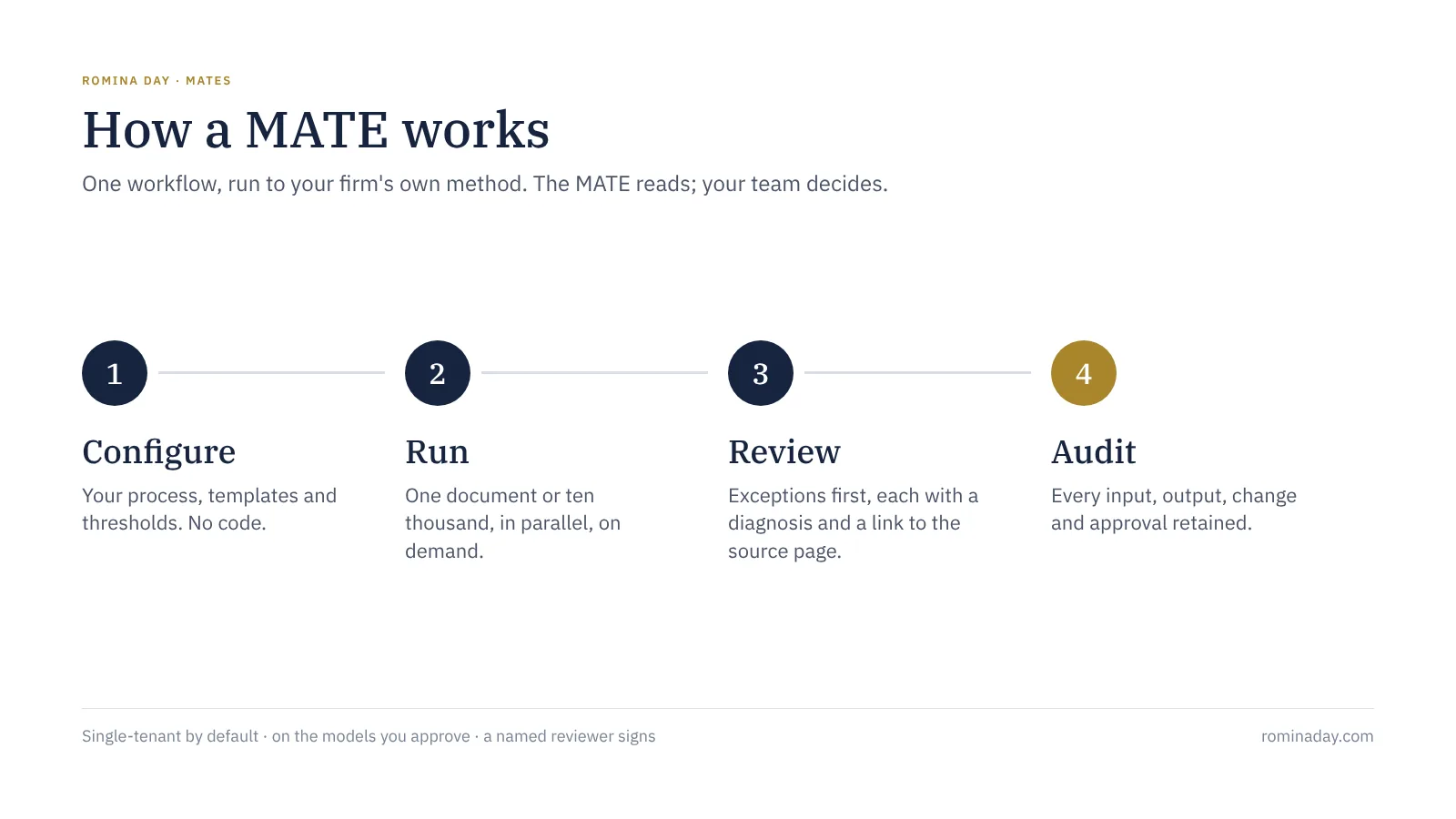
We call them MATES, our multi-agent teams. Each runs one workflow to your firm’s own method. The MATE reads; your team decides. The named reviewer still signs. What changes is that they sign with the record in front of them.
The MATES
Each MATE is ready-made and configured to your process, templates and thresholds, with no code. They run the work your teams do every day, not just at period end. You configure it, run it on one document or thousands, review the exceptions first with a link to the source, and every input, output and approval is retained.
Document and Paperwork QA. Checks account paperwork, subscription documents and client forms against your rules as they arrive, so issues are caught before they reach the client or the regulator, not found in a sample after the fact.
NAV Oversight and Reconciliation. Reconciles NAVs, positions and transactions across administrators and counterparties, whatever format they arrive in, and traces each break back to its cause, so your team works the exceptions rather than the spreadsheet.
Manager and Product Due Diligence. Reviews manager and product materials against your due diligence framework, flags what has changed or is missing, and keeps the evidence behind every assessment.
DDQ and RFP Response Drafting. Drafts responses to due diligence questionnaires and RFPs from your approved source material, so every answer is consistent, sourced and ready for your team to review before release.
Adverse Media and Entity Monitoring. Screens managers, counterparties and related entities for adverse news and material changes, and surfaces what matters with its source attached.
AFS Review and Material Flagging. Reviews audited financial statements against your criteria, extracts and ties out the figures, and flags material items, so every manager is reviewed rather than a sample.
Most institutions start with the one that matters most to their team. Every MATE runs on the same governed platform, so adding the next is configuration, not a new project.
As we approach $100 billion in client assets under oversight and continue our international expansion across North America, the UK, the Cayman Islands and the Middle East, one thing has become increasingly clear: our message is resonating. Not just in the initial workflows institutions engage us to deliver, but in the additional opportunities they identify once they see the technology working within their own operations. For me, that expansion is the strongest validation of what we're building. Clients come to us to solve one problem and quickly recognise the potential to transform many more.
We've also been deliberate about what we're not. We're not another general-purpose AI platform searching for problems to solve, or a chatbot that leaves the user to verify its answers. We're not a consultancy building expensive prototypes from scratch, or a point solution designed to address one isolated problem. We deliver production-ready, governed workflows configured to each institution's own methodology, with source-linked evidence, clear accountability and human oversight. One implementation opens the door to dozens of workflows across the business. And we don't ask institutions to replace their existing systems, AI models or teams. We work alongside them, turning the processes they already depend on into something faster, more consistent and fundamentally more scalable.
Staying distinctive is the continuous work of saying no to the typical version of ourselves.
If you run a middle or back office, start with the workflow that costs you the most hours this quarter. Thirty minutes, one workflow, nothing to prepare, nothing to sign. We’ll open by asking you to walk us through one review, step by step.